Posts

Showing posts with the label Productivity

Advise on top 3 challenges in Scrum

Image

Sense of urgency the Agile way

“You must take action now that will move you towards your goals. Develop a sense of urgency in your life.” H Jackson Brown Jr Why sense of Urgency: In a complex product development especially which is just not an enhancement but development from the scratch, a sense of urgency is very much needed.  In today's fast changing world, if there is no sense of urgency then there is a high possibility that customer will leave you soon.  Who builds the sense of urgency: Leadership team need to build this and this is done by communicating the vision and value the product development will give. if the core team who is in charge of development do not know why they are building and what is the motivation then there is a high possibility that your development team will lose focus in building a world class product. How does Scrum/Agile helps: Product owner /Scrum Master in a typical Scrum model work in a aggressive mode especially with the dependent s...

How to challenge the Agile team - tips for Scrum Master

I am often told by people who are senior to me to challenge the team and increase the productivity. After all we are in business and if we deliver more than we will in good shape. This s true to some extent as we are ultimately human beings and require some sort of push/motivation to continuously deliver more. I would address this in 2 different ways: A team that is self organized, disciplined,hard working and consistently performing then I would suggest to act as a friend and constantly ask this question " How can we improve" Let the response comes from them. It may be possible that team is doing their best however team may come up with certain areas of improvement. See as a Scrum Master if you can help them. A team which is in its initial stage and may not realize the areas of improvement on their own. In such cases I suggest to act as a coach and keep sharing the best practices with them. The little areas of improvement can change the team to the next level and b...

7 communication tip for Scrum Master

You write emails, facilitate meetings, participate in conference calls, create reports, devise presentations, debate with your colleagues… the list goes on. According to the 7 Cs, communication needs to be: Clear -  What is your purpose in communicating with this person? If you're not sure, then your audience won't be sure either. Concise - S tick to the point and keep it brief.  Concrete - There are details (but not too many!) and vivid facts, and there's     laser-like focus. Correct -C orrect communication is also error-free communication. Coherent -  All points are connected and relevant to the main topic, and the tone and flow of the text is consistent. Complete -  In a complete message, the audience has everything they need to be informed and, if applicable, take action. Courteous -  Courteous communication is friendly, open, and honest. Source -  http://www.mindtools.com/pages/article/newCS_85.htm

Cost for requirement change

Image
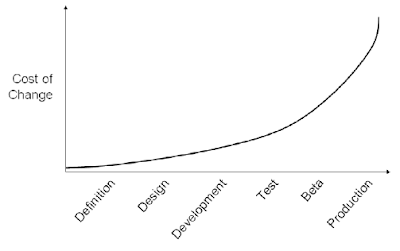
The cost of change for a traditional software project When changes to a product is introduced during the development stage because of new information or a new customer requirement, a domino effect of negative consequences followed. First, the process had to go through formal change control that was intended to ensure everyone on the team, especially those handling development and QA, understood the change and that the plan of record was kept up-to-date. This meant documentation and meetings. Second, the effort had to be estimated and, often, the schedule recast. Kent Beck, who developed Extreme Programming, asks a very thought-provoking question: if our cost curve were relatively flat (Figure 1.3) Would we behave differently?  Would we delay decisions until we had better information?  Would we over-design in anticipation of future needs or just design and build to our current requirement?  Would we be able to deliver more value to the mar...

Product Owner Dos and Don’ts

DO Say  what  needs to get done. Challenge the team Get interested in building a high-performance team. Practice business-value-driven thinking. Protect the team from outside noise. Incorporate change between sprints. Don’t Say  how  to do it or  how much  it will take. Bully the team Focus on the short-term deliveries only. Stick to the original scope and approach  “no matter what.” Worry the team with changes that might happen, until they become real. Allow change to creep into sprints. Advise from  Lyssa Adkins

Design thinking- desirability-feasibility-viability

Image
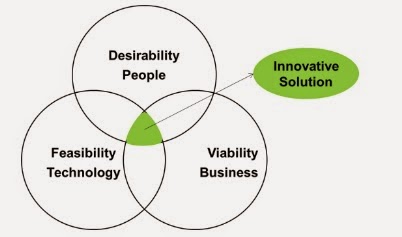
http://scn.sap.com/community/design-thinking/blog/2013/05/10/design-thinking--so-what http://forty.co/value-balancing-desirability-feasibility-viability

Strategy-->Plan-->Implement-->Maintain "Automation Testing"

Strategy First  it should be clear about what your strategy for automation is. (And don't say Automate everything. The people who think you can automate everything are just as wrong as the people who think you can manually test everything. Automation can help, but you need to know its strengths and weaknesses.) Plan Secondly, you should decide what success might look like. Most teams will do a lot better if they try to achieve something close to the testing pyramid , that being where developers write a lot of unit tests and specific integration tests with dependencies, and then a combination of devs/testers write service level, and API tests, but in a smaller proportion. lastly any UI should probably be kept small and focused on critical areas of the software (because they are so slow). Implement Another thing you should consider, is that automation efforts slow down, the further from the code it actually tests it is to develop. This means that while your testers may be pur...

15 Characteristics of a Agile Programmer

1. Impressive technical skills   Describe your experience with different programming languages. 2. Willingness to learn   What do you do to keep your programming skills current? 3. Debugging skills.   How do you handle bugs in your code? (next, I would give them a trial run to debug code) 4. Work environment match   Some programmers require complete silence to concentrate, while others thrive in chaos. 5. Problem-solving skills.   How would you create (insert near impossible task for your organization)? 6. Passion for the work. True programmers are self-proclaimed “computer geeks,” spending their time gaming, building servers, or creating apps for friends.  7. Grace under fire.   The ideal programming candidate will be able to handle even the most stressful situations calmly and, most importantly, be able to continue working. Describe a time when you were under extreme pressure and your application wasn...

3 imporatant lessons to make meetings productive from Steve Jobs

keep meetings as small as possible. made sure someone was responsible for each item on the agenda. wouldn't let people hide behind PowerPoint .                              Lessons from Steve Jobs

6 Productivity ideas in Agile

Productivity is defined as the production output per unit of input. I.e. dollars out / dollars in.  Assuming a fixed team working on a single product, your cost is (almost constant) for each sprint. The only way productivity can increase is by increasing the delivered value. That can be done by:  1) not building anything with 0 value, thus minimizing waste.  2) minimizing dead time. In software development that translates to:  - fast dev machines (minimize the devs waiting on builds and deployments).  - keep the build fast  - make deployments simple (e.g. hot deployments with JRebel)  - minimize dev env setup time (e.g. using Vagrant).  3) minimizing rework. This one translates to:  - keep the code releasable at all times using CI  - high coverage, layered automatic testing (aka agile release onion).  4) allowing the team to work uninterrupted  - minimizing external interference (including from management :) ...