Posts

Continuous Delivery - An Example

An example of an idealized, modern software delivery pipeline might look like the following:  • Plan user stories and manage issues with a project management tool like JIRA.  • Collaborate on code via GitHub pull requests or a code review tool.  • Kick off a build in a CI system like Jenkins or Bamboo.  • Automatically run unit and functional tests with open source testing tools like xUnit and other testing frameworks, and automation tools like Selenium and Appium.  • Deploy with an IT automation tool like Puppet or Chef, or using a PaaS.  • Monitor performance and impact on business metrics with systems like New Relic and Mixpanel.

Retrospection meeting using Fishbone diagram

Image
Step 1: Identify the Problem Step 2: Work Out the Major Factors Involved Step 3: Identify Possible Causes Step 4: Analyze Your Diagram Depending on the complexity and importance of the problem, you can now investigate the most likely causes further. http://www.mindtools.com/pages/article/newTMC_03.htm http://www.techrepublic.com/blog/tech-decision-maker/create-fishbone-diagrams-with-the-xmind-open-source-tool/

Set Up Continuous Integration with Team Foundation Server

Image
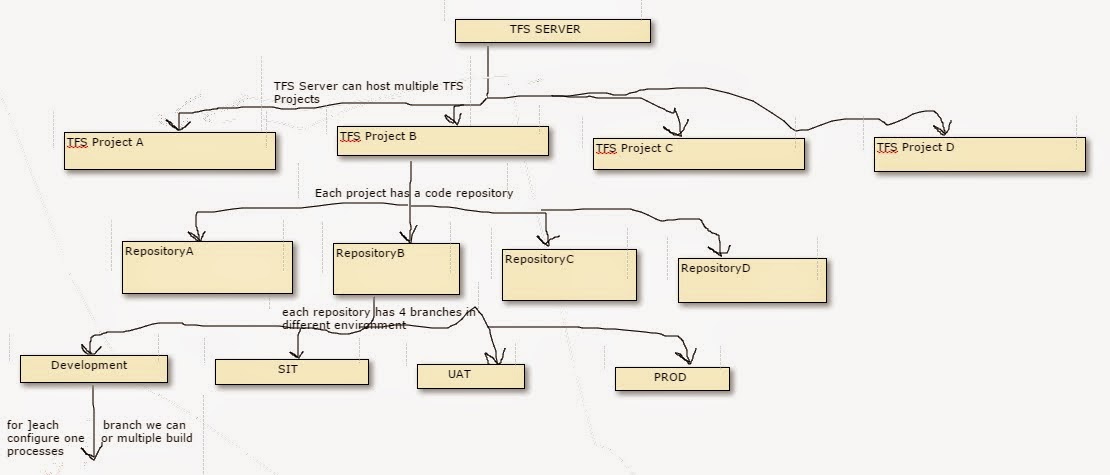
TFS infrastucture  For PROD, you may like to have Nightly Builds, for Development you want to have a build triggered at every check-in and so on…  These builds require a build server.  You can use 1 build server for all the builds or you can have a separate build server for each Repository, or you can share build server between 2 repositories. The decision to use one-build server or more depends on the peak-load, expected build queue, h/w infrastructure and a lot of other parameters.  If you do not want build services, you do not need to configure a build server at all. http://www.codetails.com/2013/11/23/team-foundation-server-understanding-the-architecture/   Set Up a Dedicated Build Server Installs the build service on the team's build server Set Up the Drop Folders A folder where the Team Foundation build service can drop the builds. Give the folder permissions to the server that runs the build service Create the Continuous-Integ...

Preparing for a Successful Negotiation - tip for Project Manager/Scrum Master

Goals:  what do you want to get out of the negotiation? What do you think the other person wants? Trades:  What do you and the other person have that you can trade? What do you each have that the other wants? What are you each comfortable giving away? Alternatives:  if you don't reach agreement with the other person, what alternatives do you have? Are these good or bad? How much does it matter if you do not reach agreement? Does failure to reach an agreement cut you out of future opportunities? And what alternatives might the other person have? Relationships:  what is the history of the relationship? Could or should this history impact the negotiation? Will there be any hidden issues that may influence the negotiation? How will you handle these? Expected outcomes:  what outcome will people be expecting from this negotiation? What has the outcome been in the past, and what precedents have been set? The consequences:  what are the consequences for you ...

Why estimate the project in Story points, a note to clients

No project can go very long before someone starts asking “When will you be done?” The best approach for estimating stories would be one that: • allows us to change our mind whenever we have new information about a story • works for both epics and smaller stories • doesn’t take a lot of time • provides useful information about our progress and the work remaining • is tolerant of imprecision in the estimates • can be used to plan releases An approach that satisfies each of these goals is to estimate in story points. A nice feature of story points is that each team defines them as they see fit. Source - Mike Cohn's book

How to handle clients using Scrum-Agile - (Tips for Scrum Master)

Tip#1 - Spend a few moments to get inside your client’s head.  Talk to them , listen carefully, figure out exactly how you need to package your ideas so that they will choose the option that’s best for their needs. Tip#2 -  Do your research and present your case clearly.  Support your design decisions with data.   Tip#3 - Build a Product backlog with clear acceptance criteria  Tip#4 -  Be specific about the project’s deliverable and outcomes, and protect yourself by       having a solid terms and conditions agreement in the event of out-of-scope work.   Tip#5- Empower team to openly share the gaps and changes in the system the client is suggesting so that you can set expectation with client for successful delivery. Tip#6- Identify the risks (Uncertainty/ambiguity in Environment,Technology,Domain) and keep a plan for this and inform to client. This can be updated on a regular DSM ( ...

Why do customers leave

Reason#1 -  Customers develop other friendship or relationship Reason#2 -  Customers get transferred to new locality Reason#3 -  Customer get competitive advantage over price/values/service and move to another competitor. Reason#4 -  Customer get dissatisfied with the product Reason#5 -  Customer are not valued ( Indifference shown to them by business owner/Manager/Employee) Critical questions to ponder: 1. How often do business research their customer to find out the level of satisfaction with the product and services that they sell!! 2.  Are the front-liner staff members empowered to make decision now or must they seek approval from higher up?

Leadership styles

There are four leadership styles: Directing, Coaching, Supporting and Delegating. o Delegating i.e. Low Supportive & Low Directive o Directing i.e. Low Supportive & High Directive o Supporting i.e. High Supportive & High Directive o Coaching i.e. High Supportive & Low Directive Situational Leadership is a way of describing and analysing leadership styles. It is a combination of directive and supportive behaviours. Directive behaviour involves telling people what to do, how to do it, where to do it, when to do it and then closely supervising this performance.  Supportive behaviour involves listening to people, providing support and encouragement for their efforts and then facilitating their involvement in problem solving and decision-making. Source-  http://business-financialrange.com/?p=1663

What Product Owner need to understand is technical debt

Generally teams take on different types of work that is  - building new features and fixing broken features that are product related. PO ideally want only new features and begrudgingly accepts defects.  - fixing poor code, outdated code that is hampering and slowing the team down in building value to the product. Developers feel they are working on 'bad' code and find new work demotivating as they have to work through pains. This is tech debt its best and Product Owners struggle to  recognize  this and see the importance.  - practice and build improvements. Introducing ALM tooling, build pipelines, automated testing take significant effort and much more than most people  realize . Teams spend months on this. Product Owners don't  realize  that this takes work to  customize  for their product as they expect it to work out the box. The reality it's not plug and play and takes effort.  PO needs some education on techni...

Agile solutions to top 16 issues with traditional project Management

- Lack of change management or understanding of it  -   Agile solution- Sprint review meeting ensures this - Stakeholder's understanding of the scope and scope creep   - Agile solution- Can be resolved by maintaining a well maintained Product backlog by the PO - Over-commitment  -  - Agile solution- This can be ensured using Team collaboration in Sprint planning in Scrum - Managing up instead of down or across the waves  -  - Agile solution- Collaboration resolves this - Allowing outside forces and management to affect your team   - Agile solution-Scrum Master protects the team - Not understanding your personnel resource strengths  -  - Agile solution- Retrospective meeting resolves this ( let the team resolve this) - not updating the schedule and taking action.-   - Agile solution- Shorter Sprint goal is set  -   Not communicating in the proper format at the proper level of the organization to affect a positive...